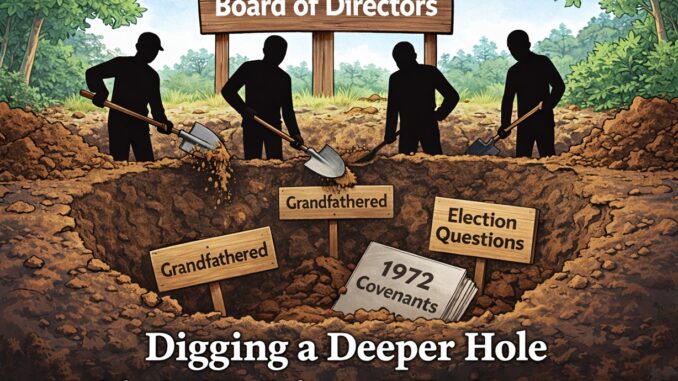

The POA Just Blew a Hole in Big Canoe’s Residential Covenants — And Their Own Documents Prove It.
The Big Canoe Property Owners Association was asked a simple question: Under what authority is a residential home (Petit Crest Villa 636 – as Office) being used as a full-time commercial office?
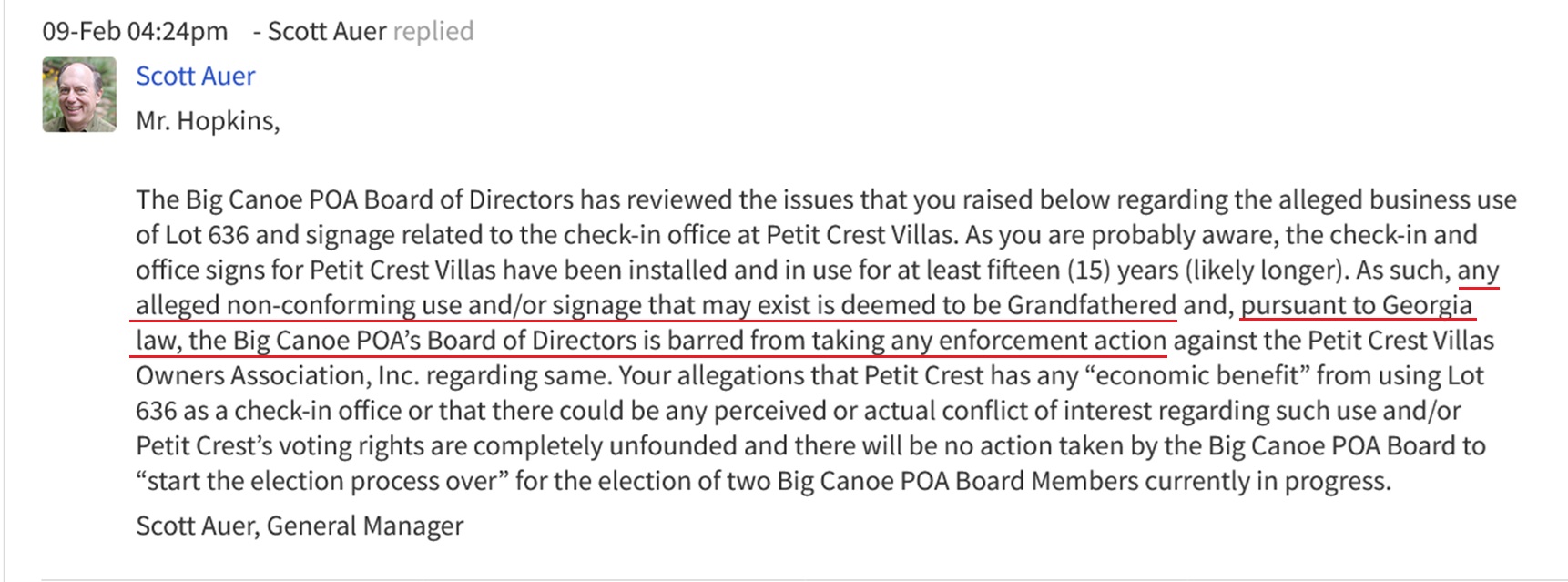
Their answer is summed up in one word: “Grandfathered.” No citation or covenant reference. No recorded amendment, nor board resolution, nor mention of any discussion in minutes. No legal opinion or analysis whatsoever.
The response may have done more damage to the enforceability of Big Canoe’s residential covenants than the commercial office itself ever could.
You can read the Original Demand Notice (6-page PDF).
You can read the Original Article.
You can read the AskThePOA.
You can read the legal Follow-up Letter (8-page PDF). <-New / Recent / WOW!
What the POA Admitted — And Why It Matters
In AskThePOA Ticket #19905, the Association characterized the concerns as “completely unfounded,” declared the commercial use of Lot 636 “grandfathered,” and stated it is “barred from taking enforcement action.”
The response cited no governing document, referenced no covenant provision, identified no recorded amendment, and attached no legal authority.
What it did confirm — publicly — is this:
- The POA knows a residential unit is operating as a commercial office.
- It has known for years.
- It will not enforce the restriction.
That admission now exists in writing — and it materially alters the legal landscape.
The “Grandfathered” Defense Fails as a Matter of Law
A “grandfathered” use exists only where a restriction was adopted after a use was already lawful and in operation. If the prohibition predated the use, there is nothing to grandfather.
Here, the commercial-use prohibition dates to the founding of Big Canoe.
The original 1972 Class “A” Covenants — recorded October 9, 1972 — state:
“All Residential Lots shall be used for residential purposes exclusively.”
They further provide:
“…such building is not used for any activity normally conducted as a business.”
That language is not a modern rule. It is a recorded covenant running with the land since 1972.
If Lot 636 is a Class A residential lot — and it is — commercial use has been prohibited from the inception of the covenant scheme.
The 2008 Rule A.13 did not create a new restriction. It clarified and operationalized an existing one. It defined prohibited business activity and allowed only narrow, incidental, non-apparent home-based activity, while retaining the explicit prohibition:
“No residential unit may be used solely for business/commercial purposes.”
A full-time staffed commercial office with signage and daily visitor traffic does not fall within those limited allowances.
Because the prohibition predates the alleged commercial use, there is no legal foundation for a “grandfathered” defense. None.
Unless the Association can produce a recorded amendment, redesignation, or other written exemption — which it has not — the claim of grandfathered status fails on its face.
Their Own Covenants Say They Are Not “Barred”
The POA claims it is “barred from taking enforcement action”, but its own governing documents say the opposite.
Both the 1972 Covenants and the 1988 Amended & Restated Declaration contain an anti-waiver clause stating that failure to enforce “however long continued” does not waive the right to enforce later.
* See the February 27, 2025 Response To The Board for the full excerpts.
The founders anticipated exactly this scenario — long-tolerated violations — and preserved enforcement authority anyway.
The POA is not barred. It is choosing not to enforce. That distinction legally matters.
So Who Benefits?
Petit Crest Villas holds approximately 64 Class A Improved Lot votes — the largest single voting bloc in Big Canoe.
Those votes are all effectively cast through Petit Crest Villas Management.
A commercial office that exists only at the tolerance of the Association is not independent. Shutting it down would impose operational and financial consequences on PCV Management. That reality creates leverage.
When the beneficiary of that tolerance controls the largest voting bloc in the community, the arrangement becomes structurally vulnerable to influence — whether or not anyone ever says it out loud.
This arrangement demands public investigation. The membership deserves to know who approved it, who benefited from it, and why the covenants were set aside.
The Election Context Makes This Worse
This lands in the middle of an election cycle that:
- Failed to meet quorum
- Was restarted
- Proceeded without publicly documented authority
- Appeared to sideline the Election Committee
The two new directors now sit in seats chosen through a process that failed quorum, was reset without transparent documentation, and continued while a formal demand regarding the largest voting bloc’s covenant violations sat unanswered. That sequence has created a cloud over the results of this election — and over the board decisions that will follow.
That cloud does not disappear simply because ballots were counted. In the Primary Election, the total voting power of Petit Crest Villas exceeded the margin separating J. Cornelius and Bob Kelley. In the General Election, the margin separating Roger Hackler and Bill Thurber was even narrower — well within the numerical capacity of that same bloc to alter the outcome.
These issues were not hidden. They were documented in multiple published articles prior to the election. No public explanation was offered. No clarification was provided. No call for pause or transparency was made.
Leadership is not measured only by winning an election. It is measured by the willingness to confront process failures when they are visible. Silence in the face of unresolved structural concerns carries consequences. Those consequences now attach to this board, including the recently elected Directors, who silently accepted a flawed process.
This Is Where Litigation Risk Becomes Real
Georgia courts have held that selective or inconsistent enforcement can undermine enforceability of restrictive covenants. Long-standing acquiescence in violations can lead to waiver or abandonment arguments. Arbitrary enforcement can be invalidated.
If another homeowner is cited tomorrow for operating a business from a residence, their attorney will ask one question:
“Why did you enforce against my client — but not against Lot 636?”
The AskThePOA response confirming knowledge and refusal to act will be Exhibit A.
The Demand Questions Were Never Answered
The January 18 Demand Notice requested:
- Written authority permitting the commercial use
- Identification of who approved it and when
- Clarification whether similar uses are allowed elsewhere
- Disclosure regarding reliance on PCV votes
- Records related to post-quorum election decisions
None were produced.
Instead, the ticket was closed.
A follow-up letter has now invoked statutory inspection rights under O.C.G.A. § 14-3-1602.
Closing a ticket is not the same as answering the questions.
What This Really Comes Down To
Either the Board has written documentation authorizing this commercial use — in which case producing it should take minutes —
Or it does not, and by its own admission this arrangement has been tolerated without legal authority for more than fifteen years.
We have already documented two elections in which the margin of victory fell within the voting power of Petit Crest Villas — margins narrow enough that the bloc alone could have altered the outcome.
How many other close elections? How many community votes? How many quorum determinations?
We may never know.
But we can ensure it does not continue — and we can protect the Covenants from further erosion, before selective non-enforcement spreads and exposes the community to avoidable and expensive litigation risk.
This didn’t happen in a vacuum. See prior reporting in this election cycle:
July 24, 2025 ~ Allegations of Election & Social Media Interference by Big Canoe POA Communications Director
August 2, 2025 ~ BIG CANOE: Why Are We Still Not Allowed to See the Vote Counts? Property Owner Demands Answers.
August 15, 2025 ~ Big Canoe POA Primary Election – Practical Guide to the 4-Vote Ballot
August 19, 2025 ~ How Big Canoe’s Election Committee Is Tilting the 2025 Board Race — and Why Every Property Owner Should Care
August 24, 2025 ~ Big Canoe: Developer’s ties to Election Chair Littleton exposed
January 18, 2026 ~ Big Canoe Property Owner Puts the POA and Its Attorney on Notice
February 6, 2026 ~ Big Canoe: Was the 2025 POA Director Election Taken from J. Cornelius?
And the above doesn’t even include the reporting done by https://bcmatters.org/ – with one article specifically that stands out for excellence – January 16, 2026 “Rogue.”
– fobc editor


Be the first to comment