
A Community’s Election Integrity at Stake
Election interference isn’t just a national problem splashed across headlines every four years. It’s here, in Big Canoe, woven into the very process that should be above reproach: choosing the people who govern our community. The latest drama surrounding the 2025 POA Board elections has crossed a line. The events of the past few weeks have left property owners asking themselves a chilling question: if we can’t trust our own election process, what else is compromised?
The Chair Who Doesn’t Live Here
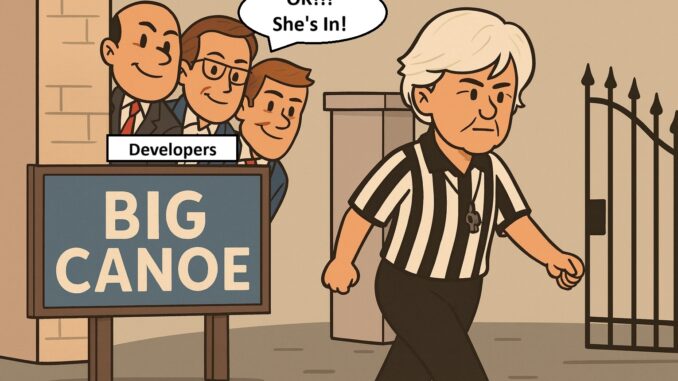
At the center of this storm is Liz Littleton, Chair of the Election Committee for the past four years. Littleton has presided over multiple election cycles, enforcing campaign restrictions and presenting herself as the neutral referee of Big Canoe’s democratic process. But here’s the bombshell: Littleton doesn’t even live in Big Canoe.
Her only ownership interest is a fractional 10% stake in an Amenity Lot, obtained through a special arrangement with members of the Developer’s team. In other words, the woman deciding how our elections are run does not actually live under the rules and covenants the rest of us abide by. Instead, she resides comfortably in neighboring Blackwell Village.
This is more than a technicality. It raises fundamental questions about conflicts of interest, legitimacy, and influence. Why was someone with such tenuous ties to Big Canoe elevated to one of the most sensitive positions in our governance structure—and kept there for four straight years?
A Pattern of Election Interference
Property owners don’t have to dig deep for evidence that the Election Committee has gone off the rails. In July, Littleton took to the community’s largest Facebook discussion group and publicly accused candidate James Cornelius of spreading misinformation through a campaign email blast. She warned him he had a “big problem” on his hands—language that sounded less like impartial oversight and more like a threat.
The accusations turned out to be false. Multiple property owners called for Littleton’s resignation, labeling her comments as “blatant election interference.” The Board itself demanded an apology. She resisted, submitting a carefully worded non-apology that was rejected by the POA attorney. Ultimately, a lawyer-drafted statement was forced out of her and posted online. But by then, the damage was done.
This wasn’t an isolated misstep. Election Committee member Bob Chestney also jumped in publicly, admonishing Cornelius over supposed “violations” of a social-media ban. He scolded Cornelius on Facebook, invoking the Committee’s authority to police candidates. When pressed, Chestney later admitted the Committee had no enforcement power whatsoever—essentially conceding that he had overstepped and misled property owners.
The referee wasn’t just blowing the whistle. She was picking sides. And her teammate was backing the call.
The Missing Candidate
Meanwhile, the official POA “Meet the Candidates” video, heavily promoted in newsletters and Big Canoe Living, presented itself as the definitive way for property owners to learn about all six primary contenders. Yet one candidate—Cornelius again—was nowhere to be seen.
Cornelius had notified the POA that he couldn’t attend the recording session due to a family medical crisis involving his elderly father. Still, the video neither mentioned his absence nor gave him an opportunity to provide remarks. Instead, the POA repeatedly directed property owners to a forum that showcased five candidates while erasing the sixth entirely. The effect was unmistakable: property owners were being steered toward an incomplete and biased portrayal of their choices.
The Communications Director Question
The most serious allegation of all, however, remains the least addressed: that POA Communications Director Delaine Faris was directly involved in urging outside Facebook administrators—people who are not POA employees—to remove or censor Cornelius’s campaign posts. If true, this is not just bad judgment. It is an abuse of power by a paid staff member interfering in an election process.
The Board has so far sidestepped this charge. But silence isn’t neutrality—it’s complicity. Until these claims are investigated and addressed transparently, property owners will have no reason to trust that their elections are being run fairly.
A Board That Keeps Looking the Other Way
The Election Committee is a Board Committee. The By-Laws make that crystal clear. Its chair, its members, and its scope of authority all derive from the Board. Which makes the Board’s repeated willingness to look the other way even more troubling.
Consider this: our Board of Directors has previously defended the appointment of a General Manager whose most notable professional credential was running a 22-person Molly Maid cleaning franchise. If this is the standard of vetting applied to senior staff, should we be surprised that the Board appointed, and then re-appointed, an Election Chair with no real residence in Big Canoe and only a fractional ownership interest connected to the Developer?
Once again, we are left asking: what does this say about the Board’s judgment, and whose interests are really being served?
The Developer’s Shadow
The fact that Littleton’s only ownership interest in Big Canoe is a minority stake in an Amenity Lot obtained through a Developer arrangement is more than just curious. It hints at the Developer’s continued influence in areas of community governance where neutrality should be absolute.
While no one is alleging that the Developer scripted Littleton’s Facebook attacks or wrote the biased video script, the connection should not be ignored. When developer-linked ownership ties coincide with blatant election interference, it raises the specter of conflicts of interest at the very heart of Big Canoe’s governance.
Subtle influence can be as corrosive as direct control. Property owners deserve to know: are our elections being shaped by the community’s collective will, or by arrangements that benefit a select few?
Where We Go From Here
The situation has spiraled far beyond a single Facebook comment or one mishandled video. This is about the integrity of the process itself. Property owners are owed answers—and corrective action. At minimum, the following steps should be taken immediately:
- Remove Liz Littleton as Election Committee Chair. Four years is long enough. Her conflicts, her behavior, and her disregard for impartiality make her unfit to serve another day.
- Remove Bob Chestney from the Committee. Publicly misrepresenting the Committee’s authority disqualifies him from continued service.
- Investigate Delaine Faris. Allegations that the POA’s own Communications Director directed outside censors to silence a candidate must be taken seriously. If verified, termination is the only acceptable response.
- Conduct a formal Board review. The Board should reaffirm that only it has the authority to adopt binding election rules. Any committee-created “guidelines” that masquerade as enforceable regulations must be suspended.
- Publish a clear, Board-approved election policy. One document, simple, lawful, evenly applied.
- Call a public town hall. Before the runoff, the Board must face property owners, explain what happened, and justify its choices.
A Closing Thought
Big Canoe prides itself on being more than a neighborhood—it’s a community. But a community cannot thrive when its elections are tainted by bias, censorship, or quiet deals in the background.
Some will say this is overblown. Others will shrug and call it business as usual. But here’s the reality: once property owners lose faith in the fairness of elections, the entire foundation of community governance crumbles.
It’s time for the Board to prove it values integrity over expedience. The question that lingers is this: if they don’t, what will property owners themselves decide to do?
Be the first to comment