

Recently we reported on the uncomfortable truth that the general public has enforceable rights to dine at Big Canoe’s restaurants and inns (full article) – rights baked into the Covenants themselves. That alone stirred up the inner fears of some property owners who like to imagine Big Canoe as a walled sanctuary. But let’s take this one step further, because the implications are far bigger – and far uglier – than just a dinner reservation.
The Board Holds the Keys – Not You
Article I, Section 1(c) of the 1988 Covenants spells it out: the “general public” has access to Common Properties “to the extent permitted by the Board of Directors.” Translation? The Board alone has the discretion to open virtually every amenity and common facility to outsiders – trails, pools, fitness center, pickleball, bocce, tennis courts, even weddings and banquets in the Clubhouse – as long as the public is not given rights greater than those already enjoyed by members, their families, guests, and tenants.
The General Manager? Irrelevant here. This is a Board-level decision only. The By-Laws are crystal clear: management carries out policy, but policy comes only from the Board. So if tomorrow the Board votes to allow Atlanta wedding planners to market Big Canoe’s Clubhouse as a public venue, there’s not a single thing the membership can do to veto it.
Guaranteed Public Rights – and Unlimited Board Discretion
Let’s not forget: the Covenants also guarantee the public a baseline right that the Board cannot touch – entry into Big Canoe to use restaurants and inns. That’s a contract with the public, not with you. Beyond that? It’s all discretionary. If the Board wants to broaden access to parking lots for public hiking events, they can. If they want to sell golf packages to outsiders, they can. The only ceiling is that the public cannot be granted more than what owners or their guests already enjoy.
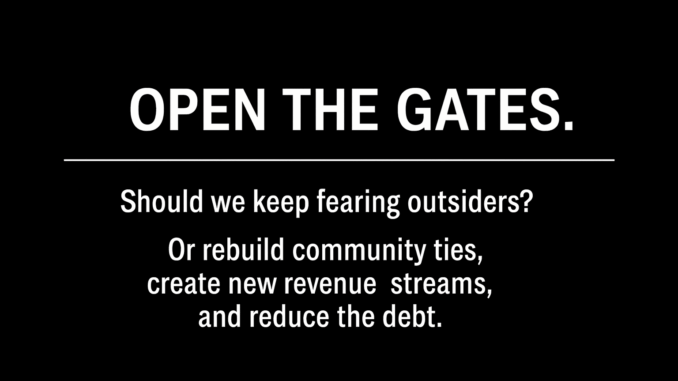
But “equal access” still means sharing the clubhouse with outsiders, whether owners like it or not. It also invites a choice: keep fearing outsiders, or restore broader community relationships – partnering with neighbors, businesses, and civic groups who can bring goodwill and revenue through the same front door.
Developer’s Rights Trump All
And don’t forget – even the Board’s discretion has limits when it collides with Developer’s rights. The 1988 Covenants (and confirmed in the 2005 Amendments) preserve the Developer’s contractual protections, including rights to tee times, golf access, and other priority privileges. The POA can play gatekeeper with the public, but they cannot impair the Developer’s retained rights. In other words: while the Board can toss you in the deep end with the general public, they still can’t touch the Developer’s seat at the table.
Fear or Opportunity?
The question is no longer whether the general public has rights here. The question is how far the Board decides to go in exercising their power to extend those rights. And make no mistake – that power is theirs, not yours.
But if some property owners can get over their fear of the general public, then perhaps this can be seen through the lens of opportunity, not fear. Imagine the potential “controlled” revenue streams – and the social dividends of reconnecting Big Canoe to the broader community – if the Board chooses to leverage its discretion:
💰 Potential Public Revenue Streams
(All fully authorized by the Covenants)
- Weddings & Banquets – Rental fees for public events at the Clubhouse could generate tens of thousands annually while forging ties with regional families and vendors.
- Day-Pass Programs – Pools, fitness, pickleball, bocce, and tennis access sold to outsiders could offset operating losses and introduce future renters, buyers, and donors.
- Public Golf Packages – Outsider tee times sold at premium rates bring in fresh green fees (Developer’s rights untouched) and broaden tournament sponsorships.
- Trail & Event Access – Charging hiking clubs or outside groups for organized events creates steady, low-cost revenue and rebuilds goodwill with neighboring towns.
- Restaurant & Bar Expansion – Marketing to the public (happy hours, catering, live music) means more covers and bar tabs and a stronger local hospitality network.
- Parking Fees – Event-based public use of parking areas creates direct cash streams with minimal investment and supports regional event partnerships.
- Paid Activities & Event Coordinators – Yoga on the beach, guided hikes, fitness runs, league sports (kickball, kids’ soccer), and special events could all be led by residents, creating direct income opportunities.
- Marina & Fishing Programs – Boat rentals, daily fishing passes, and resident-led classes or guided outings bring revenue while putting money in residents’ pockets.
Closing Punch
So maybe this isn’t about protecting some imagined exclusivity at all. Maybe it’s about money, community, and opportunity. And if that’s the case, property owners should ask themselves: whose pocket will those “opportunities” end up in — the Association’s, the Developer’s, or yours — and what kind of relationships and jobs do you want Big Canoe to rebuild along the way?

Be the first to comment