
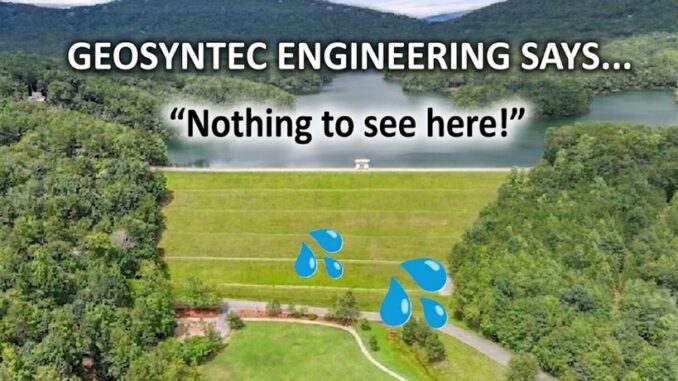
BIG CANOE, GA — The defensive machinery of the Big Canoe Property Owners Association (POA) and their multi-million-dollar engineering consultant, Geosyntec, has officially kicked into overdrive. Within 48 hours of our investigative reports documenting the worsening physical conditions of the Lake Petit Dam core, an emergency community-wide public relations eblast was launched directly into your inbox.
We encourage every property owner to completely read Geosyntec’s June 11, 2026 community letter. We have absolutely no problem republishing their defensive play verbatim—primarily because it is a masterclass in boilerplate evasion. Rather than confronting a single piece of hard scientific data compiled from their own regulatory submittals, Geosyntec chose to run as far away from the facts as corporate liability management allows.
What do you expect a firm that has spent millions of your capital reserves to say when the problem is actively expanding? Here is the raw, unvarnished truth behind their public relations spin.
1. The “Middle School” Seepage Lecture
In their public communication, Geosyntec attempted to neutralize the community’s growing alarm over expanding saturation zones with an introductory science lesson:
“Water doesn’t just press against an earthen dam; it seeps through it. The goal isn’t to stop that flow but to control it. Part of that control is measuring water levels inside the dam. Wet areas caused by slow seepage through the compacted dam material are common to earthen embankment dams.”
This condescending explanation sounds like a middle school teacher explaining how a generic dam functions on a blackboard. It completely glosses over the physical realities on the ground at Lake Petit.
If these expanding wet spots are just “common, normal seepage,” why did Geosyntec’s own engineers explicitly claim in consecutive reports that these volatile areas “will be remediated”? Why did they execute a massive $Million Dollar “Seepage Collection System Modifications” project to fix them if there was nothing wrong?
More importantly, Geosyntec completely ignored the hard mathematical metrics from their April 2026 inspection report. They offered no public explanation for why Wet Area 2 on the lower roadway slope expanded by 50%—ballooning from a width of 40 feet in July 2025 to a massive 60-foot saturated footprint in March 2026. Seepage may be a normal physical process; an expanding saturation zone directly beneath a freshly altered, failing drainage bench is a progressive structural warning sign.
2. The Piezometer Shell Game
To completely suppress community scrutiny over the volatile spikes rocking the interior of the dam, Geosyntec offered this sweeping guarantee:
“The May 2026 piezometer readings are all below pressures used in the stability analysis approved by Georgia Safe Dams. We have no concern regarding the piezometer readings in Lake Petit Dam. There are no actions needed at this time.”
This statement is intentionally misleading. When you audit the official May 2024 Final Stability Report (Table 1) filed with the state, the raw engineering metrics completely shatter this public narrative of calm:
- PZ G-2 Shallow Historical Mean: 1,570.5 feet MSL
- Official State Model Safety Target: 1,573.2 feet MSL
- The Real-World Reality: The groundwater table inside the dam has repeatedly blown right past their state calibration lines. It surged to an alarming peak of 1,575.95 feet MSL in March 2020 (+9.72 feet over baseline) and spiked again to 1,574.30 feet MSL in September 2021.
How can Geosyntec claim these readings are safely “below” the stability analysis? The answer is a bureaucratic loophole. In Section 5 of their own Stability Report, the engineers admit that the software model they submitted to state regulators was programmed using artificially high, worst-case, imaginary water pressures to force the computer to print an acceptable safety factor.
By measuring the dam’s health against an inflated, high-pressure computer simulation rather than real-world baselines, Geosyntec can pretend the actual physical water table isn’t dangerously surging. Furthermore, this marks a sudden, alarming shift in how data is reported to our community, and to State Regulators. For years, the official state-mandated reports—specifically in 2020, 2022, and 2024—provided clear, easy-to-read data tables showing the exact water level numbers for every single sensor. In the new 2026 report, those raw data tables are completely gone. Geosyntec abruptly deleted the numbers entirely. Now suddenly, as the visual evidence of wet area expansion is worsening, they are demanding your absolute trust while actively hiding the numbers. Why suddenly hide the numbers that have always been previously reported publicly?
It is also worth noting that in their response, Geosyntec completely dodged addressing the previously raised G-2 Sensor issue of whether “the instruments are becoming unreliable.”
3. The Panicked Progress Loop: What They Are Hiding
While Geosyntec publicly pacifies the community by declaring “there are no actions needed at this time”, their engineering correspondence obtained through records requests reveals a state of logistical panic.
According to an internal email dated May 22, 2026, between Senior Services Director Jamey Dotson, P.E., and the Manager of the Georgia Safe Dams Program, Geosyntec was frantically organizing emergency, unbudgeted heavy field operations on the dam face:
- Sudden Excavation: In a telling behind-the-scenes scramble, Geosyntec is sending a specialized crew to perform unscheduled drilling operations along Bench 2 and the lower toe. These happen to be the exact upper and lower boundaries of our worsening wet areas. Coincidence? Don’t bet on it.
- Undocumented Infrastructure: To do this digging, they are utilizing “air-knifing”—a process where heavy industrial vacuum trucks blast 5-foot-deep holes into the dirt. They are blindly drilling to find hidden, unmapped drainage pipes that they don’t even have blueprints for. Crucially, they are using high-pressure air instead of “hydro excavation” because they know they cannot risk injecting more water into a saturated, failing slope.
- New Maintenance: In the exact same push, they are deploying pipe cameras, jetting debris, and scrambling to clear internal drainage blockages.
If there is truly “no concern” and “no action needed”, why is our engineering firm urgently air-knifing holes into our dam face with a vacuum truck right before their next official report is due to be filed with state regulators? Let’s be completely clear: this latest drilling was entirely unscheduled. It wasn’t even on the radar until the April 2026 inspection report went live, officially documenting that the wet areas inside the dam are actively expanding. Yet, the community is supposed to believe this sudden scramble is just a “nothing burger” that has nobody worried? One thing is for certain—this is a very expensive, sudden, unscheduled activity—and the property owners deserve an explanation for why this activity that they are paying for is being conducted. By the way… did the POA tell anybody about this? Something to consider.
4. Dismantling the Myth of Proactive Ownership
The cornerstone of the Board’s public relations defense is the narrative that Big Canoe is an exemplary, highly responsible dam operator that voluntarily implemented quarterly engineering monitoring in 2020 out of pure caution. Here is their exact quote:
To its credit, Big Canoe implemented more stringent regulations beginning in 2020. Instead of every two years, Geosyntec has been hired to inspect Lake Petit Dam every quarter.
This is deception at its finest. Quarterly Inspections were never a voluntary safety upgrade. Georgia law changed way back in September 2016 to legally force all Category I dam owners to execute quarterly inspections. The POA simply spent years ignoring the law until they got caught.
In an internal EPD email dated September 3, 2020, Safe Dams Program Manager Tom Woosley admitted this about Big Canoe’s total lack of compliance: “We have not gotten inspection reports from the owner other than the one this year [April 2020].” In a formal state disclosure dated September 8, 2020, EPD officials again confirmed Big Canoe’s truancy, stating: “Our document tracking sheet reflects that the only inspection report received in the past few years is the April 2020 report by Geosyntec.”
It is the height of utter corporate gaslighting to now paint the POA as some sort of “Regulatory Compliance Saint.” The real truth is that for nearly three decades, a flood of official state communications has lectured them about Major Safety Deficiencies (1996), its Instability (1998), Non-Compliance (1998), compliance failures, overdue safety plans, ignored deadlines, and Even More Non-Compliance (2021). They finally got cornered in 2020 when the data from their First Submitted Inspection Report (overdue since 2016) showed deteriorating data, forcing them into finally following quarterly inspection guidelines!
“To its credit” my a$$. Big Canoe has been dragged kicking and screaming into regulatory compliance. Meanwhile, Georgia Safe Dams appears to have tolerated a pattern of delayed compliance by Big Canoe – that no ordinary dam owner should expect to survive without serious enforcement. Why the special treatment? And for a Category 1; High-Hazard Dam???
5. The Cash Cow and the Engineering Loop
To put this bureaucratic charade into perspective, we must look directly at the financial ledger. During the August 12, 2020, community virtual meeting, management confidently assured property owners that total dam repairs would stay “far less than three million dollars.”
Look at what has actually been drained from Big Canoe’s capital funds exclusively for Geosyntec’s consulting and engineering services since that promise was made:
- 2021 Engineering Fees: $614,065 (IRS Form 990)
- 2022 Engineering Fees: $316,015 (IRS Form 990)
- 2023 Engineering Fees: $283,530 (IRS Form 990)
- 2024 Engineering Fees: $658,623 (IRS Form 990)
- 2025 Engineering Fees: $710,951 (Capital Reports)
- Total Recent Milking: $2,583,184
Conveniently, in the 2026 financial reporting, the Board has completely restructured the budget layout. They completely deleted the transparent, itemized line item for “Lake Petit Engineering Expenses,” lumping it into an anonymous, un-auditable collective “Lake Petit Dam” total to prevent property owners from seeing the current 2026 financial drain.
We have spent over $7 Million on total fixes, an additional $9 Million capital expenditure is looming on the horizon for a full spillway replacement, and Geosyntec is currently frantically running vacuum trucks over the face of our dam in unbudgeted and previously unscheduled drainage hunts.
We are officially trapped in an engineering failure loop. Geosyntec cannot afford to admit the core is progressively saturating because it exposes their multi-million-dollar remediation designs as a failure. The Board cannot afford to tell the truth because it exposes a historic breach of fiduciary and regulatory compliance.
So they print empty, unbacked platitudes, hide the numerical data grids, and tell you there is absolutely “no concern.”
What else would you expect them to say?



Be the first to comment