
BIG CANOE, GA — For years, the Big Canoe Property Owners Association (POA) has maintained a comfortable, expensive narrative regarding the structural integrity of the Lake Petit Dam: the major internal issues are being handled. Residents were explicitly told that the spring 2025 repairs to the Low-Level Outlet (LLO) and the extensive engineering overhaul of the Bench 1 seepage collection system would definitively control the water migration across the dam’s downstream face. With those “fixes” in place, the community was led to believe the only major hurdle left was the rehabilitation of the principal spillway—a project currently facing a staggering $9 million estimate, with inflation, regulatory permitting delays, and as yet unsigned construction contract threatening to drive that number significantly higher.
But just released engineering inspection documents tell a different, far more alarming story.
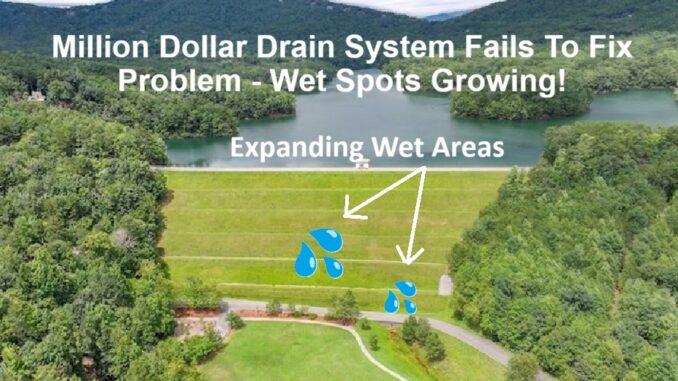
According to the recently compiled April 2026 Lake Petit Dam Annual Inspection Report (151 Page PDF) prepared by Geosyntec Consultants, the water isn’t stopping. In fact, it is aggressively spreading. The hard data inside this official report reveals that despite a million-dollar drainage system designed to dry out the embankment, the dam’s critical wet spots are experiencing rapid, unprecedented growth.
The structural condition of the dam is deteriorating right before our eyes, and the expensive “solutions” we are paying for aren’t working.
The Hard Data: Tracking the Spreading Saturation
To understand the reality of what is happening to the face of our dam, we don’t need to rely on corporate or political assurances. We just need to look at the visual and structural metrics recorded by the engineers over the last 12 months:
Wet Area 1: The Centerline Embankment Slope
- April 2025: Immediately following construction of the million-dollar bench drain, a saturation footprint was logged extending 10 to 15 feet up the slope.
- July 2025: The area expanded to 20 feet upslope.
- March 2026: The wet zone ballooned across the face of the dam, creeping a record 25 feet upslope toward the critical centerline.
Wet Area 2: The Lower Roadway Slope (Ballfield Rd. Base of Dam)
- July 2025: Engineers first documented a wet zone measuring 40 feet wide along the slope.
- March 2026: The saturation zone exploded to 60 feet wide—a massive 50% increase in width in just eight months, creeping closer to the roadway footprint.
The Weather Proof: Stripping Away the Excuses
The immediate institutional defense for these expanding wet spots is always the weather—blaming “expected seasonal fluctuations” on winter rains. But a deep meteorological audit strips away this excuse.
When the original baseline was taken in April 2025, the area had been hammered by a high baseline of 4.3 inches of rain in the preceding 30 days. By contrast, the 30 days leading up to the March 2026 inspection saw only 3.05 inches of rain—well below the historical average.
If these leaks were just normal seasonal reactions to rain, the wet spots should have shrunk under lower rainfall. Instead, they experienced the largest, most severe footprints in the dam’s history under lower-than-average precipitation. The dam is deteriorating independently of the weather.
A Cascade of Structural Failures
The expanding wet areas are only the tip of the iceberg. The April 2026 report captures a dangerous trend of degradation across multiple critical dam assets:
- Spillway Wall Core Washouts: The concrete gunite steps are progressively cracking, and water escaping the chute has actively washed away the foundational earth backfill behind the spillway walls. The structural backing is literally being hollowed out.
- Unmapped Blind Plumbing: The dam relies on an internal drainage system constantly discharging water, alongside multiple other unidentified pipes exiting near the toe of the dam. The engineers explicitly noted: “The exact routing of these pipes is not well understood.” We are flying blind on the internal plumbing of a Category I high-hazard structure.
NOTE: Following the release of the 2026 Inspection, Big Canoe / Geosyntec has been told by GA Safe Dams to immediately investigate these pipes (beginning June 2026). - Wild Core Pressure Fluctuations: Deep sensor readings inside the dam (Piezometer G-2 Shallow) are swinging wildly, showing water pressure fluctuations twice as high as the rest of the dam exhibits. Rather than investigating this as a severe internal pressure spike, the report laments that the instrument might just be “unreliable.”
An Aging Patient on Lifesupport
Built in 1972, the Lake Petit Dam is now 54 years old. It is an earth-fill structure rapidly approaching—or already past—the tail end of its engineered lifespan.
When an earth-fill dam begins showing progressive, expanding wet zones that outpace brand-new internal drainage infrastructure, it is a classic indicator of a deep internal problem: internal piping. This occurs when water slowly cuts micro-channels through the clay core, eroding the internal structure from the inside out.
Many residents in our community understand what it means to manage the realities of aging. We know the difference between a knee replacement that restores mobility and a series of cortisone shots meant to delay the inevitable. The data shows that the foundation beneath our feet is changing faster than the POA’s narrative. Are these million-dollar drainage modifications actually fixing the leak, or are they simply catching the water from a terminal internal problem and routing it away so we don’t watch the failure occur in real-time?
The Broken Promises: Political Theatre vs. Hard Science
This brings us to the political and financial reality facing Big Canoe property owners. We are being treated as an unblinking cash cow to fund expensive engineering firms and their expensive, failed bandaids.
Let’s look at the blatant misrepresentations. In the April 2024 Biennial Inspection Report (86 Page PDF), before the million-dollar seepage collection modification was built, the engineers formally diagnosed the wet, soft areas between Benches 1 and 2. They noted that 13 historical interceptor drains had “collapsed sections or obstructions,” causing water to back up into the soil core.
The POA and their engineering consultants put a promise in writing on PAGE 7, stating that:
“The area between Benches 1 and 2 was found to have localized areas that were wet and slightly soft. This area generally corresponds to the location of interceptor drains and may indicate damage to an interceptor drain, causing water to flow into the backfill around the pipe instead of flowing through the pipe into the concrete channel. The wet areas may be compounded by expected seasonal conditions during the wettest part of the year in the first calendar quarter; however, these areas will be remediated as part of the seepage collection system modification.“
They took our money, dug out the bench, put in a new 10-inch pipe, and declared “success” in April 2025.
But look at the scientific data scrutiny. Before their million-dollar “fix,” the wet areas were already a declared problem at 10-15 feet high, and 40 feet wide. Today, after the fix, the wet spots have exploded to 25 feet high, and 60 feet wide. A 50% increase in width and a near-doubling in height right after a million-dollar project is the ultimate proof of failure.
Indeed, they didn’t fix the problem. They made it worse. There is a sound reason for this also. The moment they allowed water to flow more quickly inside of this portion of the dam – it did! And the increased velocity (the technical term is “increased hydraulic gradient”) has likely started carrying away increased soil particles, making the internal piping even worse. It is the simplest explanation for the expanding “wet areas”.
The administrative claims of a “successful remediation” are nothing short of political theatre designed to extend and pretend as long as possible. The community now faces a looming $9+ million capital bill that only buys us a new spillway, completely ignoring the fact that the previous drainage bandaids on the actual face of the dam are already failing and will have to be completely revisited. The evidence suggests that the interior of this 54-year-old embankment is increasingly riddled with progressive, age-specific internal degradation and piping. No amount of expensive external drainage modifications can fix a core that is washing out from within. Residents of Big Canoe understand the reality of aging; we know that after a certain point, medical procedures are just stalling tactics to delay the inevitable.
By continuing to pump millions into temporary fixes, the POA risks leaving property owners financially bleeding and physically vulnerable. We deserve immediate, transparent, and structurally real answers before the cost of these failed bandaids becomes truly catastrophic—or worse, before we reach a final destination that requires a 10’s of $Million dollar total rebuild anyway.
It is a matter of basic fiscal sanity: we need to know the true, unvarnished state of this dam right now while the community still has the financial reserves to act, rather than wasting the money we do have on cosmetic patches, only to be forced to fund a complete reconstruction from scratch later.
Peace,
— david, Property Owner, FOBC Editor / June 6 2026

Be the first to comment